Rabat

Old and New


With a hopeful shoulder against
its thousand-year-old brother,
the new city already shows more rust
and abuse than the ancient medina,

which stands straighter than it should
after a millennium of fire and pirates
and the tearless tyrrany of
Mohammed’s intemperate sun.

Fifty years free of France,
the tall cosmopolis outside
the gates wears the fast
age of concrete and exhaust.

The new city wonders, still half
en Français and slouched
in café chairs that face out over
the bruise-blue taxis towards

the red medina walls, what is the
trick to timelessness, and what
do the buried civilizations
around the Bou Regreg have to say

about the way the Arabs
outlasted them all without
having to do much besides wait
and stay and sometimes fight.

Why is there so little left
of the Romans besides
the coins and shields of
martial ghosts that mingle with

Phoenician busts in museums that
the Berbers came before and
built and left and will see
the end of long before their own.

And those few exhumed slabs
of marble left at Chellah, bought
by the shipload for the price
of their own weight in sugar,

what are they worth now
in dirham or dollars or the
(يا الله)
useless euros mocked in the

clacking laughter that rattles like
a call to prayer from the storks atop
the walls of the hammams, and
whose nests crown the minarets.

Signs! Signs!

First Gen Poster

When I started attending Seattle University (just a few years ago!), there was a Veteran’s Center. It was a nice room with a kitchen, lots of seating at tables and booths and couches, kind of a little café where you could go study, make yourself some lunch, top off your coffee, etc. It was nice, but it was empty most of the time. Seattle U is a small school, and there probably are not very many veterans studying there. That it is in Seattle is surely a major contributing factor.

Whatever the reason, be it the low attendance or a combination of things, the Veteran’s Center eventually morphed into the Outreach Center. I don’t particularly care that it was no longer reserved solely for the military students. Though if I were more of the kind of student that SU was actively trying to create, I would have protested and decried the “erasure” of a “safe space” for my “marginalized community.”

Let me get tangential and parenthetical and very heavily digress here, too. The stance America takes towards the veteran community is a good example of the unintentional vilification of an otherwise good society. I have never been treated poorly because of my service. Not even close. In fact, I have had more people positively change their demeanor towards me because I am a veteran than I can count. Changed to be more appreciative and forgiving and welcoming. Still I have also heard more people, veteran and otherwise, claim that veterans are indeed a marginalized community in need (or at least especially and uniquely deserving) of preferential treatment in order to be allowed to rise to the status of everyday society. I don’t understand this. I don’t understand it because I have seen no evidence – but then I’ve never had need of the VA hospital – that veterans are a struggling and persecuted demographic. I have only seen the help, the preferential treatment. I have only ever seen us treated better than average, so it always shocks me to see us pitied. Even the pity is a form of (albeit misguided) status elevation.  As a result, though our society is actually perfectly good in its treatment of veterans, it appears to be quite bad. This is precisely the same phenomenon at work where racism, sexism, homophobia, Islamophobia, etc are concerned. We insist that we’re worse than we are.

The Outreach Center that grew to overtake the Veteran’s Center now included a couple of other student demographics. The one that became the most noticeable was the “First-Generation” or first-gen students. These are people who are in the first generation of their families to attend college. I was now a severely reluctant member of not just one, but two protected classes at Seattle University (but also a white male, so never mind). And as far as the first-gen thing goes, I understand, or understood, at first. It’s cool. You worked hard, or your parents did, and you’ve managed to find a new avenue of growth outside of the family business or possibly some near-squalid conditions that you were the first member of your family to be strong enough to climb from. Good job! But I noticed that it became something else, too. Look at the sign:

First Gen Poster

Look at that dangling declaration: “I belong here.” You only say that if someone has told you that you don’t belong here. This sign’s message is “I’m first-gen. Because of that, people don’t want me here, but I am defiantly attending college anyway.” Which is just plain false because, again, I have never come across any reason to believe that a first generation college student was discriminated against or looked down upon, or marginalized in any way. Not while I was in college, not before, not at all. I’ve never seen that angle played in a movie or read it in a book. Nothing. It is a form of discrimination that appears to have been manufactured out of nothing (and does not even exist) for the sole purpose of having something to stand against. And now, because of this sign and its message, we live in a world that is perfectly accepting of  first gen students, yet appears to be cruelly opposed to their success. It’s another false injustice, making our world look worse than it is. Why do we do this to ourselves? Are we not adults?

It strikes me that it’s very mafia-esque. A sort of protection racket set up by people to create a need for themselves. If you’re a first-gen student that was doing just fine (or a person of color, gay, etc), someone will come along to help you believe you aren’t doing fine. Or worse, that fine isn’t good enough. That you need help, and they just happen to be the perfect people to provide it.

How do you find that help? Follow the signs.

2016 (Asking After Your Brothers)

They say in the aftermath 
	the evil’s come out
but the evil out there 
	lives in their mouths.

So it’s something to look around
face to face, hue to hue
listen to someone being accused
	...and know...
	...and know...
the opposite’s true.

I think you dig me, Mr. Hughes

And when you said you -
a Kentuckian -
were brothers with an African
that was fine  

and I mean that the good way you would mean it
back in your place and time,
not sarcastic like we do in mine.

But I wondered (this one's harder
	...I know...
	...I know...)
could you have reached your other brotherhand
to secure a little kinship
with a white man?

Talk about fine!

The Street Sweeper


An angled Arab in a jellaba
as long as the Berber sun and with
tea-stained teeth the color of burnt sand,
stands unlooked at by foreign shoppers
because they all know that eye contact
is a contract that even a shy smile
cannot unbind. They see rugs, cheap jewelry.

The Arab tells a bowl of fish heads
here are more tourists. Another man
pulls a palm frond as bent as his back
over meat scraps, breadcrumbs, and poverty,
sweeping the King’s official decrees
and doubts of his Mohammedan descent
secretly beneath the dusty stones in the souk.

He stands and says bonjour to the kids
(the first guess is always for the French)
But the Americans say assalam
and the students and the Arab find
a few forgotten teeth to frame their
halfshared tongue. They eat the shopkeeper’s
small deceit in the heat of Moorish June.

The price of a dented teapot comes down quickly.

A cat mews and woos the noon-hot bowl
of fish heads but is sent running and spits
its hisses at a moped whose engine
ascends to match the unseen muezzin
his patient call having made its pact with
the long-gowned crowd, reaching unlikely speeds
beneath thin streets and stubborn burqas.

Honey drips long, making bees too drunk to fly.

Under the new moon of Al-Andalus
white women weigh the lure of the beach
against what risk they know exists and try
not to be fooled by trust earned in the sun.
A dutiful and deep-eyed olive ibn
is scraping the caramel crust from abu’s table,
closing shop in time for one more prayer.

The Final Bone

You can read the cold
in the austerity of porchlights
and the white soul of maple bark
that makes a shy shiver
when it guesses which star
might love it back.

But I am all halogen high beams
in this poor morning.
The final bone of an unwelcome skeleton
that won’t leave its ghost alone.

And here in the city –
with none of the long-sung
undone thunder of somewhere
less given to the living –
I am stung by lone red lights
and the odd mid-block walker
made bold by the madness
of his addictions.

Still.
He moves on.
I do all the stopping.

Yes

God has taken from us the sun, 
which loving was too much like firefly July, 
watching our brother kiss the girl 
we were too little to love 
but loved! 
with cloying loyalty anyway.

A name in a notebook 
and the little electric leavings 
	of her path across our sky.

But must we just go sunless sad, 
wearing moods like wet vestments 
at a mirthless service? 

		No!
 
We kick wet leaves 
on the cooling coals of long November
and hoist such a hard, proud December 
that our summerlost girl 
- hand still in rival’s hand - 
turns in a wistful flourish 
to look back once upon us 
and wish that she 
were half so free 
as we.

Why the Gods Stopped Answering

In a year that started with three months of march
the gods of the globe met a girl on a Hill,
fit with ambition and requests for the rights
of all of the people to be equally filled.

Great Zeus consulted the God of Abraham
and Mohammed added a surah or two.
Buddha nodded his silent approval
and Brahma saw it the right thing to do.

The wish was granted, her prayers were answered
and equality had been wholly ordained.
But the protester gathered her high-lettered signs
and marched, in her hat, right back out again.

Zeus looked at God and said “What’s this about?”
while angry Mohammed drew out his blade.
Buddha sat down and Om’d ‘til he shook,
Brahma wondered what mistake they had made.

The young woman said you’ve all done so well
in answering my prayers and granting my wish.
but by making my purpose so neatly complete
you’ve presented my hunger a cold, empty dish.

They watched her smartly set out for the heart
of the love that only they could create.
With a burgeoning army she chanted and marched
‘til she raised a new devil from an angelic state.

So Zeus and the God of Abraham shrugged.
Mohammed’s scimitar furrowed the dirt.
Buddha looked to have tuned it all out,
and Brahma just picked at a stain on his shirt.

What Just Happened?

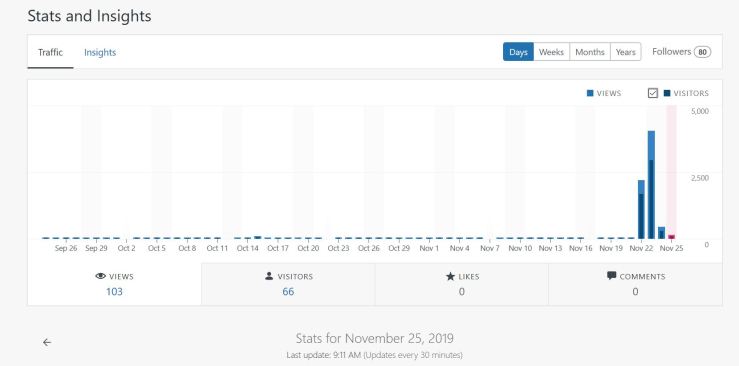
I know Glenn Reynolds isn’t exactly siting around wondering why I haven’t thanked him yet. At the rate things go over at Instapundit, I’m sure he’s already forgotten my piece that he happened to stumble upon and chose to link. Check these stats – I’m not exactly on the internet’s radar:

Instalanche Capture

The spike at the end, last weekend, was my little Instalanche moment. The feel of celebrity is a little electrifying, yes (more views in a day than in the 10 previous years. COMBINED). But honestly, there was some grime in the mix. A dirty little feeling of wondering whether I actually said something intelligent, relevant, and meaningful, or was simply chumming the waters like most everyone else. I suppose it’s all a little of both, and for now I’m happy to slide back into obscurity, sweating out an over-sentimental poem or two when the hours become available.

My sincere thanks to Glenn and everyone at Instapundit, and especially to my long-time almost mentor Gerard, whose fault this whole thing really is, anyway. Thank you also to each and every one of my followers – whether you’ve been here for years or joined up over the fruitful weekend. People say things like “You write for yourself,” but I’ve always thought that was bullshit. I do it for you. All 80 of you , haha.

IMG_2742

Signs! Signs!

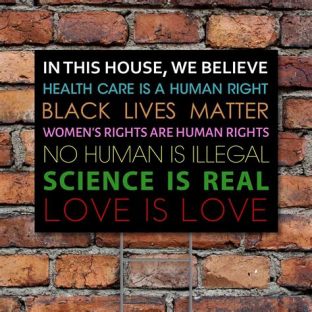
iu82DJHH9FOk, so you’ve put this sign up in front of your house. I can’t find anything to disagree with here.  That’s part of the point though, I know. It’s not terribly deep, the sarcasm implicit in the plain truth of the statements. If you don’t believe these things (and honestly, I’m still looking for someone who doesn’t), then you are The Problem.

It’s creepy how these signs act as ID badges, too, because what about your neighbors, who haven’t put up a sign? What are you saying about them? If I stand on the sidewalk and look first at their house, and then at yours, I have to make a judgment, don’t I? I’m obviously looking at two different kinds of households. At least that’s what your sign is telling me.

And what if your neighbor does put one up? And then the neighbor on the other side of you puts one up, too? Then everyone on the street follows suit? And then the coffee shops and dry cleaners? What am I to believe about the state of my world after a quick jaunt around your block? What can I believe about a world that needs signs like that? And so many? I can only believe that it is a hard, cruel place. That your house, your street, your hood, is the exception, not the rule. A tiny island of kindness in an ocean of violence and hate. Which is the opposite of the truth. The truth of our world, our country especially, is that we are a vast ocean of goodness, with (unfortunately but unavoidably) islands of despair. I would give anything to start shifting public recognition in that direction. But I guess that why I write poems. I digress…

These signs, to put it simply, are why the world seems meaner, not  kinder. Because of what they are saying, silently, about all the spaces where they aren’t. The accusations they are leveling at the world around them.


Side note, on the “Love is Love” part: I had a lit class a couple of yeas ago in which the going doctrine was that Shakespeare and his sonnets were gay (queer, whatever I’m given permission to say). Now, lawd hammercy, I can’t remember which sonnet, but the professor mentioned one of them that was popular at weddings. Her point was that, because it was Shakespeare professing his love to another man, it was hilarious that so many straight couples have had it read at their weddings. This of course revealed her to be kind of a bitter and angry person, enjoying the inadvertent embarrassment of others. But also I couldn’t help thinking:

It’s a love poem. If you believe that love is love, there’s nothing to laugh at.