Sprung Broke

I am less than three hours from my Natural Hazards final exam, and in my comfort zone. Top Pot doughnuts. A maple frosted chocolate cake doughnut and a 16oz americano. The two Washington State Patrol officers (seriously at the doughnut shop) that I sat so close to are probably annoyed because this place is mostly empty otherwise, and I nestled in to the table closest to them. Alas, I know where I like to sit. Admittedly, I would normally bristle at this very thing, but I’ve resolved to be more comfortable with proximity, and that works both ways. They’re talking about asthma inhalers.

I do have a problem, though. It’s the disinterest in studying. Half my problem is that the professor said this is the easiest test of the quarter. The other half of my problem is that if I score a 50% on this test, I still get an A in the class. The third half of my problem is that I have a philosophy paper due Friday. Why is that a problem? because I started writing it and I love it and it’s all I want to do. Sometimes you do work and think that you are making the teacher as happy to have you as you are to have him, and that’s really gratifying. Yesterday he had some nice things to say to me and the girl who thinks I’m smart because I’m old. She asked him for a hug after class, too, and it was the first time in 12 weeks that he looked unsettled. Awkwardest hug I’ve seen. Worse, probably, than Leonardo DiCaprio trying to hug the truth.

I think what I’ve liked most about this philosophy class has been that I’ve been able to be freely creative. The three papers I’ve written have been a combination of clinical analysis and rollicking imagination, and they’ve been successful. For this one it is all about Sartre, and life within all the little details of his philosophy: Negation, pre-reflective and reflective consciousness, anguish, freedom, bad faith, all kids of restrictive categorizations that somehow lend themselves to well to narrative construction. Probably largely because that is, for Sartre, what we do as humans at every moment – affirm or deny our personally crafted narrative of self, by way of a paralyzing totality of freedom. A narrative about built narratives and and our awareness of and belief in them. Being asked to write a  paper based on that is like being given ice cream for breakfast in Tahiti. We laughed yesterday at a classmate who asked how strict the page limit was and could she go over it. But seriously, how could you not?

There’s another paper. British Literature. The Lady of Shalott. She is “half sick of shadows,” and I am half sick of that poem. I chose it. I like it. But I’ve been too deep in it for too long and I don’t want to read it again for like a decade. I just have to remember to give that one a last minute once-over tonight and turn it in tomorrow when I take the final. Then the Philosophy paper and then Spring Break.

Ahhh, Spring Break. I’ve booked a flight to Mexico, but nothing too crazy. I’m old, so it’s an all-inclusive type of place that I hopefully won’t have to wander too far from and won’t get too noisy. And of course none of this is true. I’m actually just going to keep waking up at 6:30, making lunches and two trips per day to the kids’ school. I’ll probably use much of my free time to get the lawn in shape for spring – a little moss control, a little overseeding. And at some point I’ll polish the floor. It needs it.

Maybe I’ll write a poem or two.

That’s as much as I’m able to fake it for this morning. It’s time to bring out the notes and the textbook and see how far from failing my final I can come.

They’re All Days Without a Woman

If you come into the house and look closely, but squint a little bit, you might be able to just make out the diminishing line between cleaning up, and throwing things away. Though you’d be forgiven if it all just looked like the latter. Life reaches peak simplicity when the answer to “where does this go” becomes “in the trash.” Try it. You’ll sleep like a rock.

I lie to myself all the time in order to stay afloat. Kids really are a thing that have to be dealt with, such that parenting cannot simply happen as an addendum to other responsibilities. But I lie and say that it’s just another one of the things. The many things that make up a life. That’s kind of nonsense. What parenting is, is absolute proof that it is impossible to multitask. Breaking up a fight while doing dishes while making dinner while doing laundry – crap, I knew I forgot something – is not multitasking. That’s actually all one task. It is all sustained by the same pool of emotional and intellectual investment. To move from one of those things to the next, and back again, then to yet another, requires absolutely no adjustment of my energies or intentions. Fight, dishes, dinner, laundry. That’s four things right there, and it would be miraculous if the list ever stopped at that. But those four things are really all one thing. It is the mode that is your definition, and as long as nothing external gets introduced, it’s neat and tidy. It is the mode of being “parent,” and everything within it is related. Now let’s invite that other task over there. The one that looks hungry and cold on the doorstep:

  1. Break up a fight
  2. Do the dishes
  3. Fold the laundry
  4. Get dinner ready
  5. Start writing a 7 page paper for British Literature.

No way, right?  You cannot do that and the rest of the job in some sort of tag team symbiosis where everything gets in on the action and builds toward completion. The other 4 items on the list live together in a completely different compartment of consciousness. What does this all mean? What’s the big picture? How does this relate to harmony and value and identity and non-linear social progress? Not sure. But I do know that the “Day Without a Woman” didn’t get us any closer to the answer. I’ve met a few at-home dads over the last few years, and they generally get at least 5 days a week without a woman. They (we) would almost certainly prefer a different arrangement, but then again they (we) understand needs and compartmentalization and utility far better than your au pair does.

And so the mind also compartmentalizes. No matter how much I wanted to be able to start Writing that British Literature paper about the Lady of Shalott yester – GOOD EFFING GOD

Live and uncut – I was typing this because the morning was going cleanly. Dog fed and put outside, kids eating pancakes, things moving along. This is how quickly it goes to hell:

“Papa, can I have a side dish of fruit with my pancakes?”
“You already had some. You want more?”
“Yes, please. But I don’t really like more strawberries and blueberries.”
“That’s all we have, bud.”

Since then he has pulled books off of bookshelves, punched his sister, thrown toys across the house, and refused to get ready for school. Obviously, it’s not really about the fruit. He probably wants Cheetos or something, and knows that I’m just going to say no, and he’s afraid to ask and the whole thing is more than he can handle in his 6 year old mind. It’s hopelessly frustrating for him. Easy as 2+2=4 for us, harder than trigonometry for him. I know this, but no amount of kindness or empathy can change his brain chemistry such that we can resolve the situation with calmness and reason. We board up the windows and ride out the storm, and if we are really running out of time before a change in the winds, then we get a little physical.

The result of the whole thing, in this other little space over here, is that now I can’t write anymore, because I have to close that particular compartment completely, and open the “Dad” compartment. I’m sure as hell not going to be analyzing Tennyson against the backdrop of Victorian England.  Before I can do that I have to point the attention of my reader back to that non-linear social progress I mentioned earlier, and say that I can get back to my paper when I get a day with a woman.

The boy has just told me (mind you, because all we have for fruit is strawberries and blueberries) that he wishes I would “go in a trash can and never come out.”

Just Don’t Look at The Other

Anybody want to read my Philosophy One-Pager for today? Sure you do. (“Philosophy,” as well as “remember,” are probably the two words that I mis-type the most frequently. Odd redundancies of letters.) I had fun writing this one, and as has happened a few times in this course, I wished that I could write more. Alas, the assignment is limited to “not much over 250 words,” so there.

You Say Potato, I Say I’ll Go Cry in the Corner

The Other is a refreshing introduction, because it has seemed pretty obvious that things were going to get messy for Sartre as soon as someone else came along and started making meanings for things at the same time that he was. However, I am not certain I agree that consciousness has to forfeit its positionality on things to the Other. After all, the Other would necessarily have to suffer the same fate in my presence. A room full of people is just coincidental, mutual dis-integrations with no sustainable claim on meaning. So why is this forfeiture necessary? Is it simply strict adherence to post-modernism, the requirement of the movement to eliminate the self at the earliest convenient opportunity? Maybe it’s better than that. Maybe it’s because, as I am not him, I cannot know what these things are to him or for him. They have to transfer allegiance to the Other, because for me to have any amount of ownership of their distance or relation or meaning to him is an absolute impossibility. He disintegrates my ability to rationalize – to positionalize – my world, because he owns meanings that I cannot conceive, for objects that I do perceive. The Other is the antithesis of consciousness.

So the objects in my universe have a new focal point. I have been eliminated as the locus of positionality. Seems that, by extension and because it must necessarily be the same from the perspective of the other, that he is also eliminated as the locus of positionality, and on and on in saecula saeculorum, such that there is no such thing, anywhere, as a locus of positionality. All meaning dies, and we place the corpse of morality on the pyre alongside it.

As noted, Sartre leaves gaping vacancies where morality and ethics are concerned, though I hear he made a run at those things eventually. For now I enjoy the challenge of digging through his oily narrations and coming up with some understanding. There’s a lot to like.  A lot to agree with.

Medium, on the other hand, is yet to be decided upon. I joined up last week. No matter how many times I click “show fewer stories like this,” or “show fewer recommends from medium staff,” I still get stories like that, and recommends from medium staff. And they’re all the same droll political drivel. However, there are also many poets and writers (not mutually exclusive, those two, natch). If my exclusions eventually yield a primarily creativity-friendly experience, then maybe I’ll be on to something. Someone posted a poem there today, for instance, that referenced Descartes in a playful way. I pointed out that he had also invited Sartre to the party through some of his lines about forward-looking identity. It’s timely and engaging and fun. And I won’t link to it, because it’s probably illegal or something. Medium is, like, a big and serious internet operation. Meaning that there’s more things you can do wrong there than right.

Imma go off to school now and try to do some things right. It’s working out that way so far.

Our Inner Divinity

fullsizeoutput_1130

Sven(!) asked me to read the poem I wrote in class today. No, wait. I didn’t write a poem in class today. I wrote a poem last week, and turned it in as an addition to an assignment. Today, in class, Sven(!) asked me to read it. I posted it, but don’t remember if I mentioned anything more about it in the previous post, so I’ll mention it here: this was for philosophy class:

(The False Sartre)

I can point my hands at numbered things
and I can perch upon the wall.
I can wear a face you see right through
and I can speed or I can stall.

But I cannot be the time I tell
nor the alarm you’ve come to hate.
I can only be what I am not yet
and wake you up with your bad faith.

There is no concise way to describe why that poem makes (some small) sense for Sartre, so take my word for it. But I read the poem out loud for my class, and felt surprisingly calm and secure about doing it. Last quarter at South Seattle College, my creative writing teacher set up a poetry reading for us in the auditorium on campus. There were forty-ish people in the audience (including my class), and I was miserable reading up there like that, but I hadn’t presented anything for anyone since an OPORD or two in the Army fifteen years ago. It went well. During this current quarter at Seattle University I’ve done two presentations in my Natural Hazards class, and now today, the impromptu poem reading. I think it’s all starting to feel a little more normal. Which will help when I read my poem at the release party for Fragments Magazine. It’s not that poem up there. We’ve been over this.

Major subject change, but something happened today while I was studying in Starbucks that made me think for a while. Made me wonder about myself and my reactions to things: A girl dropped an F-bomb, and it bothered me. What I am wondering is whether it is fair that I know it wouldn’t have bothered me if it was a man. Well, wait – that’s not actually true. It would still have bothered me, but differently. So that’s the fairness I’m wondering about, and here’s the difference: a man swears needlessly in public and I think “what a jerk.” A woman swears needlessly in public and I think “you’re better than that.” I become disappointed. Context matters, of course. My wife can swear around the house (THOUGH SHE NEVER HAS.) and it’s no big deal (IT WOULDN’T BE A BIG DEAL IF SHE EVER DID IT. WHICH SHE HASN’T. EVER). It’s private and domestic. Our standards don’t lower because we’re home, but our expectations do shift with the intimacy of naked tooth brushings and handling dirty underwear. If Mother Teresa swore in a flower shop I’d feel The Apocalypse bearing down. If she swore in the bathroom I’d tell her to light a match.

The public sphere is different. We need to represent, to some extent, our higher selves. Not through any overt displays, and I’m not expecting rampant sainthood, but looking closely enough at someone should reveal a glimpse of some faint tether to inner divinity. Especially in women. Men, however, I have mostly given up on. We are hopelessly vulgar and mundane. Clever and powerful and packed with potential that is often realized, yes. We heave our creations out of the muck for general consumption, but we never come clean ourselves. We are rotten and banal and probably beyond redemption. We can be good people who do good things, but to hear a prim and proper, well-dressed sort of man walk down the church steps after mass and say “Now where’d I park that fucking car” would give me no pause for disappointment. No feeling of letdown. I expect this expulsion of discernment, because we lost our claim to the throne probably as far back as Cain. A man displaying social and cultural impiety has all the meaning of an off-leash dog shitting on a pool deck. You’d rather not see it, but it’s exactly as much as you can hope for.

When, on the other hand, I see (as I did today), a similarly prim and proper woman, with hair and boots and everything done up “just so” and exemplifying all the wonder and elevated being that men have lost completely, say “some fucking freshman,” I am sharply disappointed. It comes out as a spurned deification from someone who had a chance, man. Another fallen angel.

Now don’t get me wrong, if she has facial piercings and neck tattoos and is standing behind protest signs, I don’t expect anything more from her than I do from a man. She’s made her move, and it is a permanent diminution. But to have, as women do, a GPS with the route to The Kingdom in its presets, and then to follow HBO into an underground cockfight instead, well, it’s just kind of a blow to any general sense of optimism I might be carrying around.

Not a very big blow, though. My inner divinity knows where it’s at and what it’s not. And I still get to read poems out loud to my philosophy class.

Transgressions

fullsizeoutput_1114

“Transgress.” Because you have to have that edgy, sometimes-crime-is-right vibe going on. But of course, it’s college after all. They aren’t going to say “Uphold Current Social Norms.” Imagine how hosed college would be if things were generally ok. What would people at colleges do if they weren’t moved to transgress all the time? (Please, by the way, nobody tell them that the current social norms are them. They’ll get too boring.)

I can’t remember the last time I transgressed,  – wait, I can. I remember sitting in my first back-to-college class, a week or two in. We’d been split into small groups, and as I sat there with four kids in their late teens and early twenties, I had cause to say “Are you asking who cares about it? I do. I am one. I care a great deal about what happens to white males.” While caring about my future is a rather perfunctory and mundane thing to me, it’s what transgression is in 21st century America.

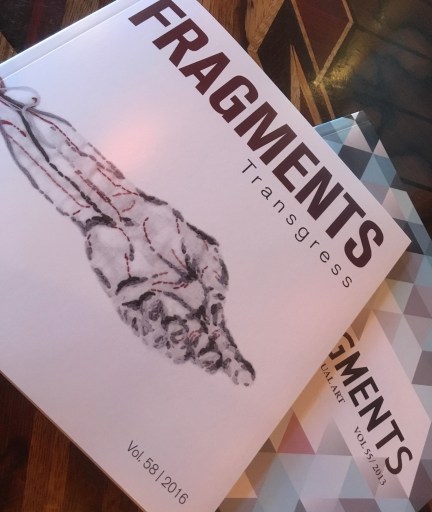
Clearly, at 41 years old, I still cannot help myself from showing gratitude through insult and cynicism. “Fragments” is the literary magazine at Seattle University, and they’ve selected one of my poems for publication. But you know this. I was able to  get hold of last year’s edition, with a bonus 2013 copy thrown in for free. The worries that I had about being the only submission, or in some other way seeing my elation diminished, are put to rest. It’s a good, heady collection of very high quality work. I am in good company, and in every way justified in feeling just tickled as hell to be a part of it. Though in honesty, if I was the only submission, I would still consider myself poet laureate of at least my home, and present my work as enthusiastically as ever.

Somebody commented on one of my Facebook posts “So you’re a poetry guy. Cool.” I find it odd, first, that he is just now seeing that. But I don’t usually put my poetry on FB, I put links to my poetry there. I know that people don’t look closely at everything. They don’t click through. And this is not a reactionary lamentation. We can’t look closely at everything. We choose, mostly unconsciously, what sorts of things to plaster onto our days.  To choose everything would crush us, then turn us inside out. Parenting, for instance, is often an involuntary capitulation brought on by too many things choosing you. And if you haven’t felt crushed and inside out after mad morning with kids, fights over toothbrushings and HURRY UP WE’RE LATE, feed the dog and no, the dishwasher still needs to be unloaded, and SERIOUSLY NO SOCKS, then you don’t have kids. It’s the closest to lost you’ll ever feel. Helpless. The parent knows it. The crime victim knows it. The soldier knows it. And it’s all because, as I said already, too many things have chosen you. We are limited, but discerning. The world is neither.

But yes, to end it quickly and get off to school, I am a poetry guy. I need to put it to good use. I am not a crusader, not a protester, not a fighter. But if anything needs a transgressor right now, it is poetry. Not as the boring “voice” against the world’s evils. That anyone is still writing about oppression or bad presidents is depressingly unhelpful. Poetry itself needs to be transgressed against. To have it dragged up from its self-obsession, pulled by its collar from the cave, subsumed, ultimately, by its own protests. And to start celebrating knowledge again. I promise to make it fun.

What Just Happened?

How does one go about celebrating one’s first publication? I say, I do it with lofty, rather British sounding English. I’m quite chuffed, and all that, even if it makes me sound a bit toff.

Dear Andy Havens,

Thank you for submitting to Fragments. We have decided to publish The Whole Sky, All at Once in this year’s edition. You will be invited to read/present your piece at a later date, this May. We look forward to seeing you there.

I’ve already made the obviously poor decision of wondering whether mine was the only submission, and that took some of the wind out of my sails (or took the piss, if I’m to stay on the British thing). But it’s an annual publication, so I have to believe that at least a few poems were dropped in the queue over the course of the submission period. I don’t know how long that period was, as I saw a notification for it just 2 days before it closed.

They have given me email addresses to contact concerning this whole thing, and I certainly will, what with that whole part about “read/present your piece.” Maybe I’ll do the ugly thing and ask how many other submissions there were. Maybe I’ll save myself the disappointment. I don’t know.

Here’s the big winner. It’s not the first time I’ve posted it here:

The Whole Sky, All at Once

You can’t look for the lightning
Dad said
or you’ll never see the flash.
He would pull the Buick out to the street
and we sat like crooked teeth
in the yawning maw of the garage.
A storm coming deliberately at us
and the tornado siren
wailing with a bored urgency
like the ambulance of the great plains.
We pulled over.

You can’t look for the lightning
Dad said
or you’ll always just miss it.
He would talk about seeing the whole sky
and we sat like crooked teeth
in the yawning maw of the garage.
We tried to look at nothing and everything
while the old corn across the street
whispered with a quickened urgency
like the dying secrets of the great plains.
We closed our ears.

You can’t look for the lightning
Dad said
or someone else will see it.

Careful With That Analysis, Eugene

Dry Foot Bwoy

“By writing this in rhymed iambic pentameter, Louise Bennett has sort of shoe-horned her Colonial Jamaican language into a traditional, white, almost entirely male literary form, and made it hers. It’s very impressive, and a powerful message.”

“Ummm…”

“Oh dear God what now, Andy?”

“So is it because it’s Thursday, or for some other reason that now we’re celebrating cultural appropriation instead of condemning it?”

No, I didn’t say that. I didn’t say that because you can’t. I didn’t say that because it is the “other reason” for which we were celebrating this kind of cultural appropriation. Literary analysis is frequently suffocatingly mono-directional. There are simply some analyses that are not allowed. I did say this:

“The family moved to England. They live in England. One of them got out of the house and learned to be English, and his whole family has shunned and ridiculed him for it. Haven’t we anything to say about them?”

We had nothing to say about them, except “bravo.” And so I didn’t say anything else.

Bt it’s all so obvious and so easy. Imagine, for a moment, if a white family moved from Texas to Jamaica and refused to pick up any of the dialect. Refused to sound in any way Jamaican. Refused any level of assimilation. The Republic of Friggin Texas was gonna stand tall and wave its Lone Star flag in a suburb of Kingston. And then one of their sons grew dreadlocks and opened a bar selling jerk chicken or fried conch or something, came home saying shit was all irie, mon, in his best Jamaican Patois, and then the Texas family wrote a reggae song full of “ya’ll” and “ain’t” to celebrate the fact that they kicked him out for being too black. And then Jamaicans in Jamaican colleges applauded them for it.

Small wonder I am feeling less and less capable of succeeding in there. I’m going to have to limit the depth of my interrogations if I want to finish as strongly as I started.

I have a different kind of problem with Philosophy. If I worry at all about my success in that class, it is because it is hard.  Thank God for the A on my most recent paper. The one about a foundational human principle. My thesis statement went like this:

The first principle of the human person is that we bond to things that are not ourselves, and we have no meaningful existence until we do that bonding.

Not world-shaking stuff, and not necessarily what I would say to the question next week. Turned out to be fairly prescient when we began studying Sartre, who is a big fan of consciousness needing something to be conscious of. I developed it well and impressed my professor, so mission accomplished. Have an excerpt:

This is sticky, but if my theory does not eliminate god (and it does not), then it also does not eliminate permanence or ubiquity. The bonds of art with audience are downstream bonds, subject to the bonds that came before, and move beyond what we’ve already discussed, into the realm of social relevance. They are not foundational bonds. They supplement or reinforce our existence, without being responsible for it. Therefore the bonds of meaning that the arts offer to us are sharable and broadly applicable across humanity. Interpretations can be common and shared, because the found meaning is the permanent thread. The social implications of “The Lady of Shalott” do not infiltrate the world as the isolated reactions of its readers, rather as the communal discovery of moral truths. Namely that, in her case as in ours, we are meaningless as long as we remain separated and unbonded from reality. That breaking out of confinement in order to bond with Truth is a permanent expression of The Good, and worth dying for.

It’s interesting, in light of that sample, that I am struggling with wrapping up a paper analyzing the Lady of Shalott for British Literature. Literary analysis has a restriction that philosophy does not, which is that in literature it can be bad to get too philosophical. In philosophy there is no such penalty for being too literary.

Thanks for being here lately.

Get Bothered

Every time I’m all “maybe I’ll major in Philosophy,” something like this happens. The one-pager I am turning in today, after having Sartre forced upon me:

Readings from Group 2. Also Not-Group-Two. Also The Nihilating Interrogation of Both Group to and Not-Group-Too. Also Peter Wears Skis to the Café. Also My Mother Would Be So Confused.

I get Peter and the café. I get the nothingness of the café, the nihilation of its parts and sounds and smells into a ground that exists only to serve as a backdrop against which I get to know whether Peter is there or not. And I get why Peter not being there is a persistent nothingness – the café simply cannot help itself from showing me Peter’s absence absolutely everywhere in it:

“Look! There’s not Peter!”
“Thank you, café!”

Wellington and Valery don’t matter, and that’s cool, too. I have no expectation, and therefore have not initiated any nihilation to ground, and they remain unrelated to the café.

But WHAT IS GOING ON after this? I am the questioner, and I want to know whether Peter is at the café. My question supposes both Peter-at and Peter-not-at-the-café. My question creates the possibility of the non-being of Peter, because that’s what all questions do. My question supposes Peter, not-Peter, the café, and my question instantiates the nihilating withdrawal (to nothingness?) of the café. But why do I need to “wrench” myself “away from being” in order to make this possible? Is it because if the question originates from me, is connected innately to my being (“determined in the questioner”), then it no longer has any necessary tether to Peter or the café or their negations and nihilations at all?

It would definitely be easy to do the old “why bother” in a case like this. But I’m not a 41 year old Junior in college for “why bother.” I’m gonna bother, until it bothers everyone how much I’m bothering.